Scalp Reconstruction Cancers or trauma can leave large defects in the scalp or areas of missing hair (alopecia). Large rotational flaps or sometimes tissue expanders (balloons) are needed to re-establish the hairline (remove areas of alopecia) and close complex scalp wounds. Dr. Nicholas Bastidas is a plastic and reconstructive surgeon specializing in the treatment of pediatric and adult craniofacial, cleft and vascular abnormalities. Dr. Bastidas is a leader in craniofacial surgical procedures and serves the Long Island and greater New York region. Call us today at (516) 497-7900. We are looking forward to serving you and your...
Read More » 
Craniosynostosis Craniosynostosis is an abnormal fusion of one or more of the growth plates of the skull. It is relatively common, and can occur in as many as 1/1800 live births. It can be non-syndromic, meaning it occurs as an isolated event, or can be part of spectrum of deformities known as a syndrome. Non-syndromic is far more common, and is thought to occur possibly due to pressure placed on the skull in utero, though no one really knows exactly. The growth of the skull is restricted perpendicular to the fused plate which can lead to a deformed head shape and increased pressure on the brain. The orbit (eye socket) and face may also be impacted as a result. Metopic – The metopic growth plate (suture) lies between the forehead bones and is now thought to be the most common craniosynostosis. It normally fuses around age 8 months, but early fusion can lead to a narrow but pointy forehead with closely set eyes (hypotelorism). Surgery involves expanding the narrow forehead and the top part of the eye sockets (supraorbital rim) Sagittal – The sagittal suture runs longitudinally in the middle of the skull, and craniosynotosis can cause a head shape that is very long and narrow. The forehead and the back of the head (occiput) often bulge. If caught early (before the head shape is too deformed), removal of the fused suture and helmet therapy can lead to good outcomes. If late, typically two surgeries are needed to shorten and widen the skull, one for the back part and one for the front part. Unicoronal – Fusion of the unicornal suture produces a characteristic head shape that is trapezoidal. The forehead and eye socket on the affected side slope back, the back of the head flattens, and the other side often sticks out. The bones of the nose may slope towards the affected side and the chin often deviates to the opposite side. Surgery involves reshaping the affected bones. Lambdoid – The rarest of the craniosynostosis, A fused lambdoid suture causes a flattened back of the head with a large bulge behind the ear (mastoid). Multisutural – if 2 or more growth plates are fused the head shape can be severely deformed and place extreme pressure on the developing brain. Many syndromic craniosynostoses are multi-sutural and surgery is aimed at first relieving the pressure (by expanding the vault) and then by reshaping the bones. Surgical Techniques: Suture release and helmet – This technique involves removal of the fused growth plate which will allow the brain to expand and then placement of a helmet for four to six months to help shape the formation of the developing skull. When identified early, this technique works great for sagital synostosis and may even be performed endoscopically (minimally invasive) Cranial vault remodeling – the gold...
Read More » Dermoid Cysts Dermoid cysts are masses (bumps) commonly found in the region of the nose, eye brow, and scalp of young children. They may grow with age and can cause inflammatory reactions or an infection when they rupture. The permanent treatment involves surgical excision of the cyst in its entirety. Cysts in the region of the nose and eye may have extension to within the skull and sometimes an MRI will be necessary to determine the depth of excision. Dr. Nicholas Bastidas is a plastic and reconstructive surgeon specializing in the treatment of pediatric and adult craniofacial, cleft and vascular abnormalities. Dr. Bastidas is a leader in craniofacial surgical procedures and serves the Long Island and greater New York region. Call us today at (516) 497-7900. We are looking forward to serving you and your...
Read More » 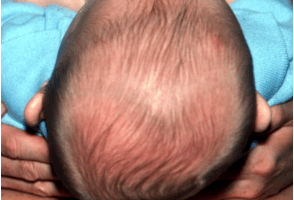
Deformational Plagiocephaly External forces from compression in utero or from molding by lying on the back of the head can cause an abnormal head shape known as deformational plagiocephaly. The compressed back part of the head induces a compensatory bulging of the forehead on the same side leading to the classic trapezoidal shape skull when viewed from above. . Sometimes this can be the result of neck muscle spasm (torticollis) which may require physical therapy to allow the head to fully move from side to side. The treatment involves repositioning your child, tummy time, and sometimes a molding helmet may be needed for 4-6 months. Earlier intervention leads to superior outcomes. It is important to not overlook the possibility for craniosynostosis as a cause of the abnormal head shape, which would not get better without corrective surgery. Will an abnormal head shape affect my child’s intelligence or development? Deformational plagiocephaly unlike craniosynostosis has not been linked to intracranial pressure (ICP) and thus is not thought to result in any developmental delay. However, children with poor muscle tone and developmental delay have been shown to have higher incidences of deformational plagiocephaly (since they do not move their heads to relieve the forces). When should we start helmet therapy? Typically 6 months How many hours a day must the helmet be worn? 23 hours/day ideally Dr. Nicholas Bastidas is a plastic and reconstructive surgeon specializing in the treatment of pediatric and adult craniofacial, cleft and vascular abnormalities. Dr. Bastidas is a leader in craniofacial surgical procedures and serves the Long Island and greater New York region. Call us today at (516) 497-7900. We are looking forward to serving you and your...
Read More » Most major medical insurances are accepted. In addition we participate in New York Hotel Trades Council for Plastic Surgery and Hand Surgery. Please call (516) 497-7900 with any...
Read More »


